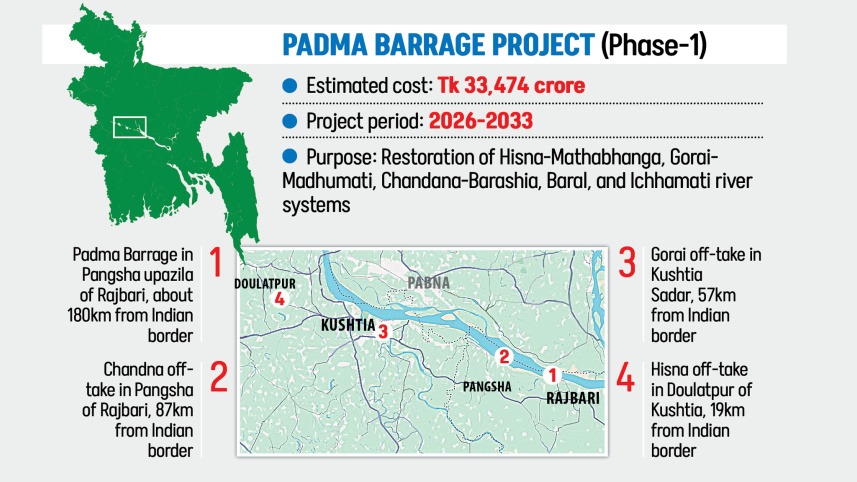
The government is set to implement the much-anticipated Padma barrage project at an initial cost of Tk 33,474 crore, aimed at reviving five major river systems and storing 2,900 million cubic metres of water in the Padma river.
Covering about 37 percent of Bangladesh’s land area, spanning 26 districts and 163 upazilas across four divisions, the Padma-dependent region has long suffered from water shortages due to upstream diversions.
The barrage is expected to be a game-changer for agriculture, fisheries, biodiversity, and economic growth.
The project gained momentum after a meeting on May 6 with Prime Minister Tarique Rahman, where he highlighted the project’s potential impact on GDP and gave directives for its implementation.
The feedback was incorporated and the proposal for the first phase is set to be placed before the Executive Committee of the National Economic Council on Wednesday for approval.
The first phase would be paid from the government’s own funds and it includes the construction of the 2.1km-long Padma barrage at Pangsha in Rajbari district.
Hydropower plants will be set up at Padma barrage and Gorai off-take, which is the crucial entry point of the Gorai-Madhumati river. The plants will generate 113 megawatts of electricity.
The other works include Gorai off-take with 15 spillways, fish pass, navigation lock, and hydro-power plant (36.6 megawatt); Chandana off-take (four spillways); Hisna off-take (five spillways); and construction 180km afflux bund.
The Hisna off-take, often referred to in conjunction with the Hisna-Mathabhanga river system in Bangladesh, is a critical component in water management designed to restore flow from the Ganges river system.
The off-take is part of wider efforts to combat silting and ensure water supply during the lean season, acting as a crucial channel for diverting water into regional rivers like the Hisna.
However, activities under the first phase will directly benefit 19 districts and 120 upazilas in four divisions: Khulna (Kushtia, Meherpur, Chuadanga, Jhenaidah, Magura, Jashore, Narail, Bagerhat, Khulna, Satkhira), Dhaka (Rajbari, Faridpur, Gopalganj), Rajshahi (Pabna, Rajshahi, Natore, Naogaon, Chapainawabganj) and Barishal (Barishal, Pirojpur).
The second phase includes construction of additional supportive infrastructure and restoration of Chandana-Barasia, Baral and Ichhamati river systems.
Five river systems -- Hisna-Mathabhanga, Gorai-Madhumati, Chandana-Barasia, Baral and Ichhamati -- would be revived.
The revived river flows will reduce salinity intrusion in the southwest, restore biodiversity in the Sundarbans, and improve drainage and irrigation.
It would ensure water supply to the Ganges-Kobadak (GK) Irrigation Project, the North Rajshahi irrigation project, Godagari pump house, and Rooppur nuclear power plant.
The project would ensure irrigation for 2.88 million hectares of net cultivable land and boost the annual production of rice by 2.39 million tonnes and fish by 2.34 million tonnes.
The idea of a barrage on the Padma dates back decades.
Between 1960 and 2000, four studies were conducted to identify suitable sites. In 2005, a detailed feasibility study was launched, completed in 2013 by a consortium of local and foreign consultants.
The study highlighted dry-season water scarcity due to upstream withdrawals at India’s Farakka Barrage, which has severely reduced flows in Bangladesh, drying up river systems and damaging agriculture, fisheries, navigation, and biodiversity.
https://www.thedailystar.net/news/bangladesh/news/tk-33474cr-padma-barrage-set-govt-nod-4172701